
01
Advocacy, Policy and Systems Change
A collective voice that integrates ageing into national and state development agendas.


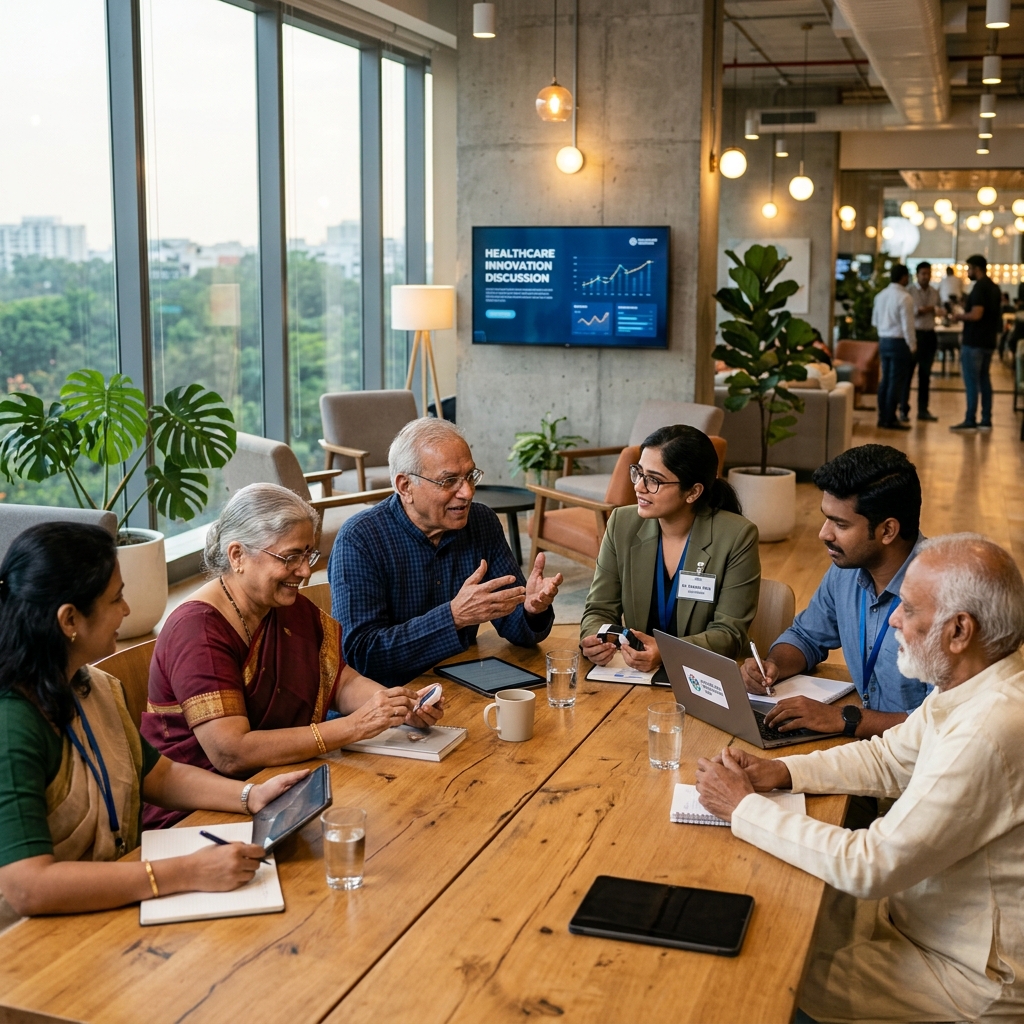
Bringing civil society, researchers, healthcare, and policy under one unified national response for healthy ageing in India.
India is ageing
India is moving from being perceived as a young country to one where healthy ageing must become a mainstream development priority. The numbers describe both the scale of the need and the size of the opportunity.
300 million
Older Indians by 2047
India's older adult population is projected to reach 300 million by 2047 and to become the largest in the world by 2067.
15 years
The gap between living long and living well
Healthy life expectancy in India stands at just 58 years against a life expectancy of 73 — a 15-year gap of ill-health that civil society has barely begun to address.
230 million
Indians aged 60 and above by 2036
Up from 100 million in 2011. Kerala, Goa and Tamil Nadu already report the highest older adult proportions and old-age dependency ratios in the country.
Sources
Why AHA exists
India's civil society response to ageing is fragmented, underfunded and lacks connective tissue. Proven models rarely travel beyond the sites that created them, and no single voice carries the sector's evidence into policy.
Organisations across elder care, dementia, longevity science and healthy lifestyles work in parallel rather than together.
The median annual budget of leading ageing-focused NGOs remains under ₹1 crore, even after two decades of operations.
Advocacy is siloed, leaving longevity and ageing policy reform without a unified national voice.
Scale-up of demonstrated community care models beyond their original sites remains elusive.
Research, practice, policy and industry have no shared platform through which to meet, learn and act together.
The Association for Healthy Ageing is a collaborative platform — the unified voice the longevity ecosystem lacks. It brings together service providers, innovators, policymakers, researchers and the private sector to build a shared national response to ageing.
Connecting the ecosystem
AHA does not sit above the ecosystem — it sits between its parts. Select any group to see how it connects.
AHA brings together organisations and stakeholders across longevity science, healthy lifestyles, elder healthcare and dementia care under a unified banner — building bridges across disciplines and sectors.
Select a group in the diagram — with a pointer or the keyboard — to read how AHA connects it to the rest of the ecosystem.
What we do
AHA's work is organised across eight mission areas that together span the four quality-of-life dimensions the Dalberg framework identifies as foundational to longevity: economic security, health and well-being, freedom to participate, and social connectedness.
A collective voice that integrates ageing into national and state development agendas.
A life-course approach to prevention, health span and longevity science.
Elevating dementia, cognitive health and caregiving as national priorities.
Participation, accessibility, dignity and social inclusion in everyday places.
Connecting organisations, professionals, researchers, innovators and funders.
Visibility and adoption of AgeTech, digital inclusion and assistive technologies.
Sector reports, policy briefs, evidence repositories and measurement frameworks.
Competency frameworks, standards, good practices and learning opportunities.
AHA's focus is not on addressing gaps already being adequately serviced by its member organisations.
Explore All MissionsOur collaborative philosophy
Healthy ageing spans healthcare, dementia, caregiving, financial security, social inclusion, workforce participation, housing, technology and research. No single sector can carry it. AHA's role is to bring together People & Community, Government & Policy, and Infrastructure & Institutions.
People & Community
Civil society and communities
Service providers, community organisations, caregivers and older adults themselves — the organisations already creating impact whose work AHA exists to enable, strengthen and amplify.
Government & Policy
Government and policymakers
National and state governments, regulators and policy institutions, engaged through a structured interface that carries collective evidence into policy and systems change.
Infrastructure & Institutions
Industry, innovators and private sector
Innovators, AgeTech developers, healthcare providers, philanthropies and industry partners whose capability and capital create pathways for replication, adoption and scale.
Knowledge and evidence
AHA facilitates the development, dissemination and application of knowledge across the ageing ecosystem — translating research into practical action for policymakers, practitioners and communities.
Sector reports
Building a shared evidence base on what older adults actually want, and on the underserved issues the sector has yet to measure.
Policy briefs
Translating what members and research partners know into briefs that support engagement with national and state governments.
Frameworks and standards
Competency frameworks, minimum care standards and evidence repositories that strengthen organisations across the ecosystem.
Note for editors: this section is built as a repeatable list. Published reports, briefs and resources can be added as new items without any change to the layout.
As India's population ages, the systems that support them must be strong, inclusive and future-ready. That takes all of us.